The Chalk Stream
Historic Maritime Sketch – "The Artist", 1906, Commercial Pacific Cable Company, USA to China Cable.
Historic Maritime Sketch – "The Artist", 1906, Commercial Pacific Cable Company, USA to China Cable.
Couldn't load pickup availability
Share
After Jean-Louis-Ernest Meissonier’s self-portrait, "The Artist".
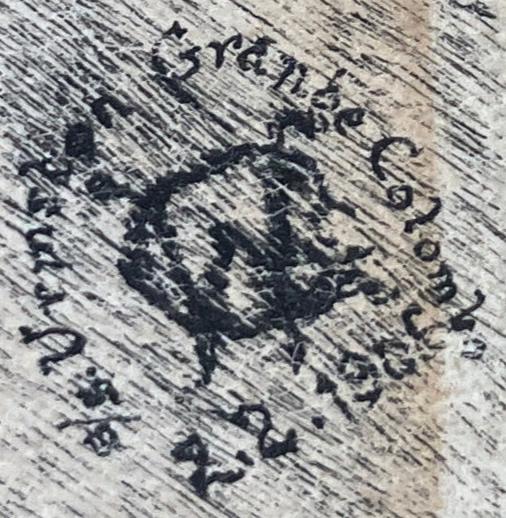
Sketch in ink aboard the CS Urmston Grange, on Feb 2, 1906, while moored in Colombo, during the vessel's historic voyage to complete the final connections on the first telegraph cable between America and China.
Black ink, paper on card (code SN4-51673).
The crew's artist, either C.W. or W.C. is identified in the ornate monogram bottom right, alongside the date and the ship's location. He or she may have been an officer, architect, or journalist-style sketcher employed as recorder to the historic events of the voyage. The decision to reproduce Meissonier’s work was likely linked to the engineering fetes of those aboard and the historic nature of their mission.
Meissonier’s original piece is a self portrait: The Artist; a self-reflection.
Jean-Louis-Ernest Meissonier (1815–1891) was one of the most celebrated French artists of the 19th century, known for his precise, detailed depictions of historical scenes, often with an emphasis on military subjects. He was considered the greatest artist of his day, and was the highest paid.
“The Artist” depicts Meissonier as a man deep in thought, engaged in the creative process. It’s a reflective, introspective image, capturing the artist’s role in society, his solitude, and the intensity of creation.
This might have appealed to the ship's recorder as part of a larger, historic endeavor—someone whose role in the great technological project was crucial, but who might have still had moments of reflection on the voyage.
Successful completion of the cables were considered major events of the day, celebrated by large crowd, numerous dignitaries, brass bands, and reported in the New York Times and other international newspapers.
An officer aboard a ship like the CS Urmston Grange would have felt a similar sense of purpose. The ship's artist would have had both the artistic training to replicate an intricate piece like Meissonier, and the intellectual background to appreciate its themes of reflection, individuality, and legacy.
The CS Urmston Grange was a 340ft length ship commissioned by Siemens Bros in 1906 on behalf of the British majority-owned Commercial Pacific Cable Company (CPCC). Registered in America, CPCC laid the first direct trans-Pacific telegraph cable, connecting the USA to China.
The 6,912-mile cable revolutionised global communication, dramatically reducing message transmission times across the Pacific, by linking the USA to Hong Kong, Philippines and Japan. The project saw China become one of the first Asian countries connected via direct undersea cable to the United States, helping integrate them more into global trade and diplomatic relations at the time.
The Guam-Bonin Islands cable was laid in 1906 by Siemens AG for the Commercial Pacific Cable Company, a major historical trans-Pacific telegraph line. The cable connected the American-controlled island of Guam to the Japanese Bonin Islands, forming part of a larger network that linked Guam to Manila, Shanghai, and San Francisco. This specific segment was crucial for maintaining communication with the East and was a significant piece of early undersea telegraphy infrastructure.
The sketch monogram is framed with the inscription “C/S Urmston Grange Colombo”. The artist's date 2.2.1906 accurately places the vessel moored, or passing, the Sri Lankan capital, shorty before works started on the Pacific cable later that year.
This sketch is a rare example of maritime art that blends personal expression with historic documentation – a priceless piece for collectors of both early 20th-century art and global communication history.
Siemens Bros manufactured and laid a 909 nm cable between Guam and Bonin Island in the Japanese archipelago in 1906 using CS Urmston Grange as a cableship. CS Silvertown was also used for this section of work.
Commercial Pacific Cable Company is now part of American Telephone and Telegraph (AT&T).
Urmston Grange was sunk as blockship at Scapa Flow in 1914 to stop enemy ships and act as anti-submarine defences.
Details
Signed: C.W. or W.C
Inscribed:
Condition: Marks commensurate with age; please study photos.
Presented: unframed, mounted