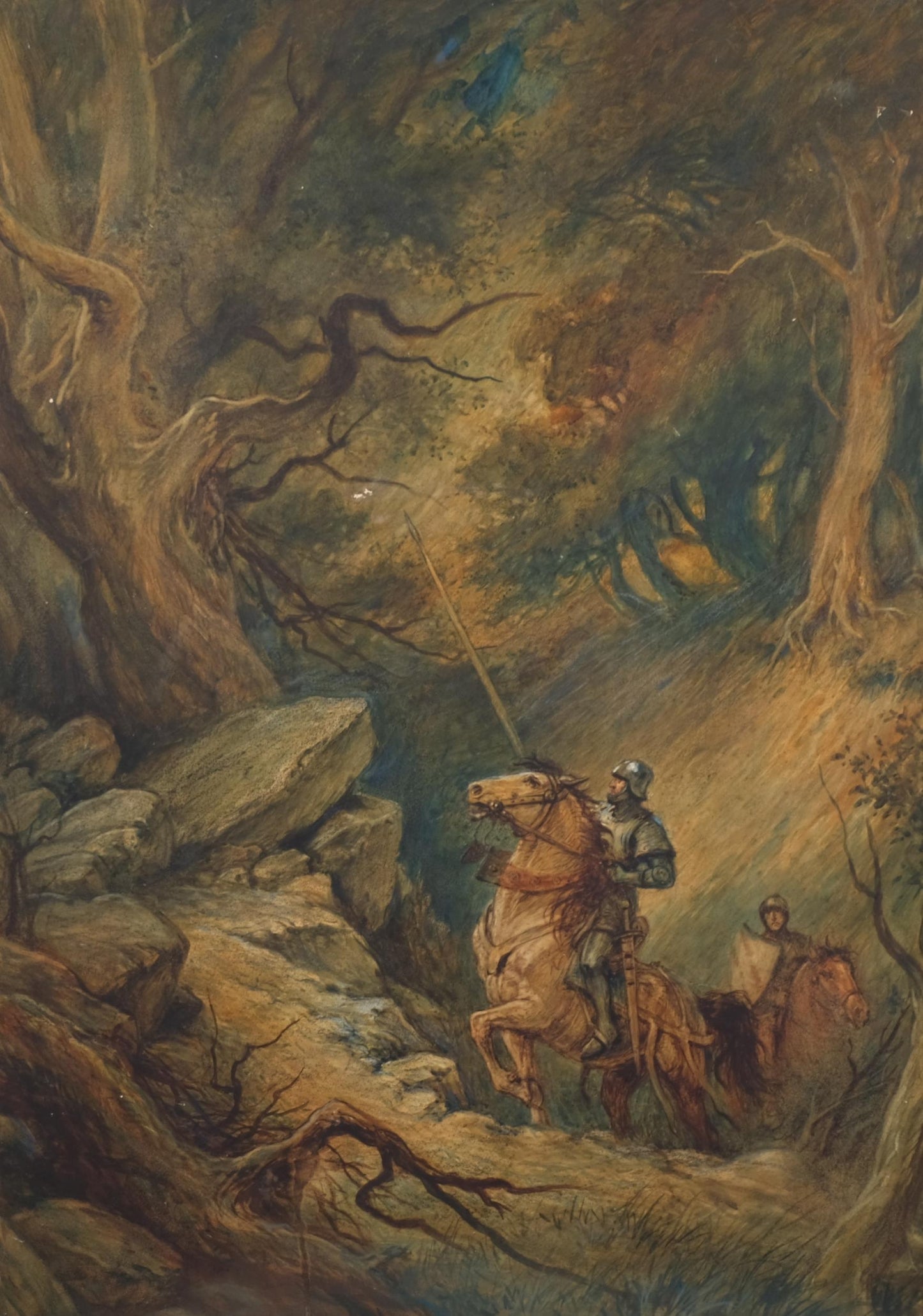
The Chalk Stream
Knights of Offa's Dyke Watercolour, Style of Paul Hardy (1862-1942)
Knights of Offa's Dyke Watercolour, Style of Paul Hardy (1862-1942)
Couldn't load pickup availability
Share
Style of Paul Hardy (1862-1942) Knights of Offa's Dyke, Wales and England watercolour.
An important work linked to 15th century civil conflict between England and Wales, specifically the national uprising led by Owain Glyndŵr (image attached above). SN-30-056,22
Hardy was an English artist , best known for his illustrations in The Strand Magazine. Although a prolific watercolourist, he did not exhibit at the Royal Academy until 1890.
The Knights of Offa's Dyke were an ideal subject for Hardy who was adept in medieval and ancient story telling.
His knowledge of armour in particular was profound.
Hardy was a skilled metal worker and made his own replica armour. He was an advisor to both the Armoury Department at the British Museum and to the Auctioneer Sotheby's. He was granted a Civil List pension of £80 in 1932, and a Royal Academy pension of £50 seven years later in recognition of his contribution to the study of medieval arms and armour.
Here, the artist tackles themes of Arthurian myth, early medieval chivalry and pagan symbolism in the classic Hardy style. Chivalric motifs in the painting are combined with more traditional themes of reverence for England's leafy, ordered woodland to the east (right of picture), and twisted wilderness and rocky chaos in the "wild west" of Wales (left of picture). These themes pre-date the medieval Norman period, demonstrating a link between a pre-Anglo Saxon past, and present. The Dyke encapsulates this connection to past and present, male and female, better than anywhere else in Britain; not least because Offa's Dyke is the nation's longest monument.
The frontier between east and west was dug from earth by the Anglo Saxon Offa, the King of the Mercians, during the 780s. It is considered the greatest national monument in Britain, covering 82 miles of Welsh and English border between Prestatyn in the north, and River Severn, near Chepstow, in the south.
Recent excavations have confirmed that a wooden breastwork ran along the top of the bank, and in places this was later rebuilt in stone. The west side of the bank was also revetted with turf to create a near vertical face.
Unlike Hadrian's Wall in the north, it was not a barrier. Garrison towers to indicate a permanent military presence have never been found.
The artist explores the picture's historic, cultural and social significance. He cleverly linked these themes in his life-time to both Blakean notions of British nationalism, and Britonic and Euro-Asian pre-history.
Details
Signed: –
Inscribed: –
Condition: Condition commensurate with age. Some surface scratches and blemishes
Presented: Framed (no glass) and mounted